Introduction
nfsen-ng is an in-place replacement for the ageing NfSen web frontend. It sits on top of the existing nfdump tool suite and adds real-time SSE push, a responsive interface, and a choice of RRD or VictoriaMetrics as the storage backend, without changing how nfcapd itself captures traffic.
Who this is for
Anyone already running (or migrating from) NfSen/nfdump to monitor NetFlow traffic: source and destination breakdowns, protocol and port distributions, flow search, who-talks-to-whom, and threshold alerting, all served from the nfcapd files nfdump already writes.
The shape of the app
A sidebar leads to seven pages:
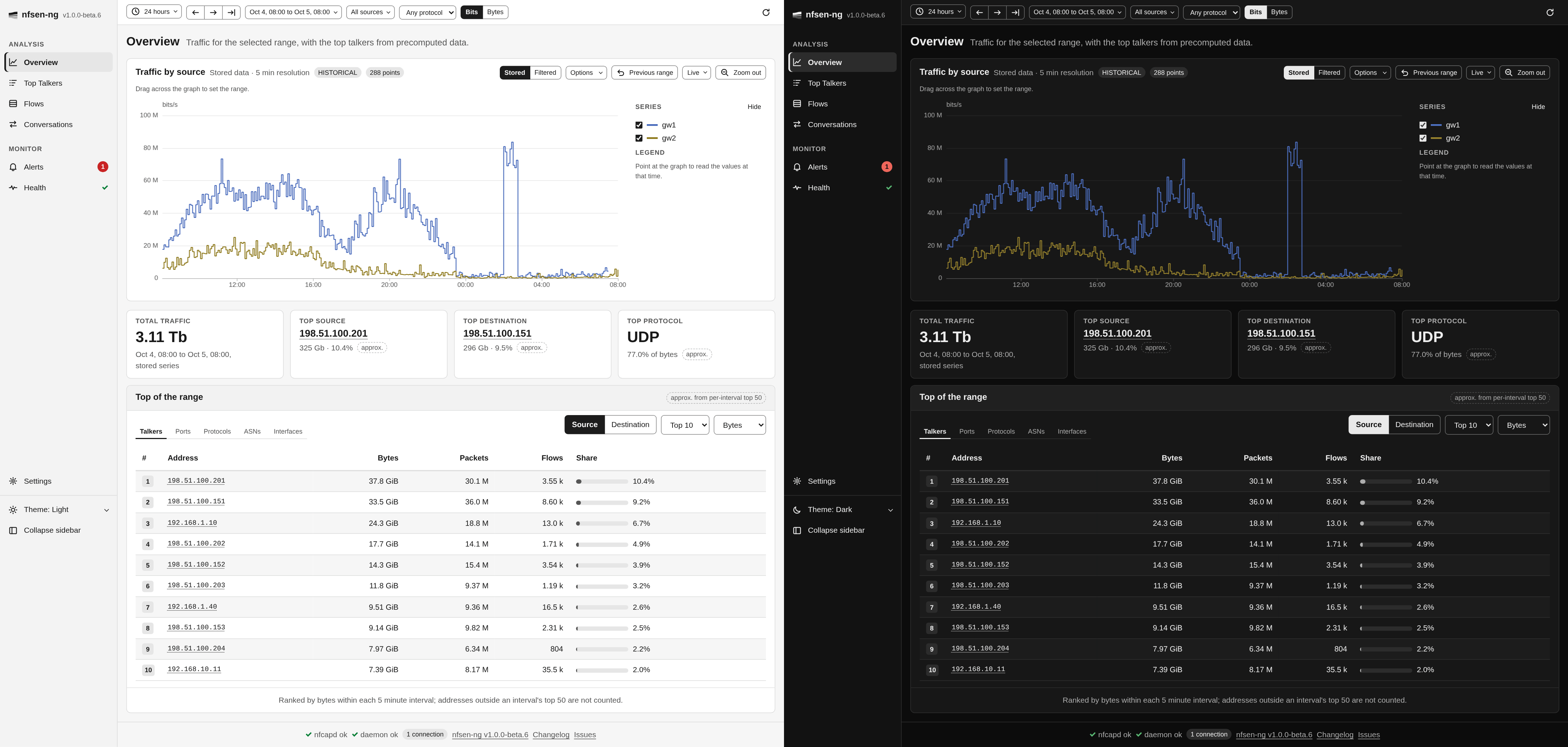
- Overview: the traffic graph with key figures and the busiest addresses, ports and protocols of the range, from data collected during import.
- Top Talkers: exact top-N rankings by any statistic nfdump offers.
- Flows: individual flow records, their raw nfdump output and a summary.
- Conversations: source and destination pairs as a Sankey, a Matrix and a ranked table.
- Alerts: threshold rules and their fired and resolved history.
- Health: the import, capture sources, disks, checks and the recent log.
- Settings: preferences, and how the instance is deployed.
A controls bar on top sets the time range, sources, protocol and unit for all of them, and the traffic graph above every analysis page doubles as the range picker. Anything that reads capture files runs only when you press Run, after showing what it will cost.
Every page has its own address (#/flows), but it’s one route (/) on the
server. The server side is PHP 8.4 running on OpenSwoole
coroutines via a small in-house framework
(php-via), pushing UI updates to the browser
over Server-Sent Events using Datastar. There’s no
separate REST API and no client-side framework build step: the server renders
Twig templates, and Datastar patches the DOM. Time series live in RRD or
VictoriaMetrics; saved filters, alert history and the precomputed top-N live in
an SQLite file next to the preferences.
To get it running, start with Installation and Configuration. The Quick Tour walks through the interface; the Architecture chapter covers how the pieces fit together; and Development covers running it locally.
OpenSwoole’s FreeBSD/other-BSD port is unmaintained (openswoole/ext-openswoole#233), so nfsen-ng currently requires Linux.
Status
This book documents the v1.0.0-beta.5 line and the unreleased changes on top of
it; see the Roadmap for what’s tracked and what’s next, and the
changelog for what
changed.